Zimbabwe
Where the earth roars and the stone remembers
Zimbabwe is a country that lives in the space between ancient and alive. The stone ruins of Great Zimbabwe stand as proof of a civilisation that thrived centuries before European contact. Victoria Falls, one of the largest waterfalls on earth, throws up a wall of spray visible from 50 kilometres away. And in the bush, the walking safaris are among the best in Africa, led by guides whose training and knowledge set the standard for the entire continent.
It is a country that has weathered more than its share of difficulty, and the scars of its recent economic and political history are real. But Zimbabwe's people are among the warmest and most resilient you will meet anywhere, the wildlife is thriving in parks that many visitors still overlook, and the value for money compared to its more expensive neighbours is genuinely remarkable.
Zimbabwe gained independence in 1980 after a long and painful liberation struggle. The country has some of Africa's highest literacy rates, a deeply educated population, and a cultural richness that runs from the stone sculptures of Tengenenge to the mbira music that UNESCO has recognised as an Intangible Cultural Heritage of Humanity. For travellers willing to look past the headlines, Zimbabwe offers some of the most rewarding and least crowded safari experiences in southern Africa.
Highlights
Victoria Falls
Victoria Falls is one of the Seven Natural Wonders of the World and the largest curtain of falling water on earth. The Zambezi River, over 1,700 metres wide at this point, plunges more than 100 metres into a narrow gorge, creating a thunder of spray and mist that the Tonga people call Mosi-oa-Tunya, "The Smoke That Thunders." The rainforest fed by the spray, the bungee jumping from the bridge, and the sheer overwhelming scale of the falls make this one of Africa's essential experiences.

Hwange National Park
Hwange is Zimbabwe's largest national park, roughly the size of Belgium, and home to one of the largest elephant populations in Africa. Over 100 mammal species and 400 bird species inhabit the park, and the network of pumped waterholes during the dry season creates some of the most reliable and spectacular game viewing in southern Africa. The park is big enough and quiet enough that you can spend entire days without encountering another vehicle.

Great Zimbabwe
The stone ruins of Great Zimbabwe are the largest ancient structures in sub-Saharan Africa south of the Sahara. Built between the 11th and 15th centuries without mortar, the walls of the Great Enclosure rise over 11 metres and enclose a space that was once the heart of a powerful trading kingdom. The site gives the country its name, and standing among its walls is to feel the weight of a civilisation that at its peak was connected by trade to China, India, and the Middle East.

Mana Pools National Park
Mana Pools is a UNESCO World Heritage Site on the banks of the Zambezi River in northern Zimbabwe. It is widely considered one of the finest walking safari destinations in Africa, where experienced guides lead you on foot through floodplains and forests populated by elephants, lions, wild dogs, and hippos. The park has a raw, unfenced quality that makes every encounter feel immediate and real. The sunsets over the Zambezi from this park are legendary.

Matobo Hills
The Matobo Hills are a landscape of enormous granite boulders stacked in impossible formations across a vast area of southern Zimbabwe. The hills hold one of the highest concentrations of rock art in southern Africa, painted by the San over thousands of years, and are also home to one of the densest populations of leopard anywhere on the continent. Cecil John Rhodes chose to be buried here, on a hilltop he called "View of the World," and the panorama from that point is extraordinary.

Lake Kariba
Lake Kariba is one of the largest man-made lakes in the world, stretching 220 kilometres along the Zambia-Zimbabwe border. Created by the damming of the Zambezi in the 1950s, the lake is now a destination in its own right: houseboat safaris glide past submerged forests where fish eagles call from the dead trees, and the Matusadona National Park on the southern shore offers excellent game viewing with the lake as a backdrop. The sunsets over the water are among the most beautiful in Zimbabwe.

Gonarezhou National Park
Gonarezhou means "Place of the Elephants" in Shona, and the name is well earned. This remote park in southeastern Zimbabwe is part of the Great Limpopo Transfrontier Park, connecting to Kruger in South Africa and Limpopo in Mozambique. The Chilojo Cliffs, towering red sandstone formations along the Runde River, are one of Zimbabwe's most dramatic landscapes. The park is wild, relatively undeveloped, and offers a frontier safari experience that is increasingly rare in Africa.

Eastern Highlands
The Eastern Highlands run along Zimbabwe's border with Mozambique, a chain of mountains and valleys that feels completely different from the dry bush and savanna of the rest of the country. Misty peaks, pine forests, waterfalls, and rolling green hills define this region. Nyanga National Park and the Chimanimani Mountains offer superb hiking, and the cool mountain air comes as a welcome relief from the heat of the lowlands. It is Zimbabwe's most unexpected landscape.

Geography
Zimbabwe sits on the high plateau of southern Africa, bordered by Zambia to the north, Mozambique to the east, South Africa to the south, and Botswana to the west. The country is roughly the size of Japan or Montana, and its landscape is more varied than many visitors expect.
The central plateau, known as the highveld, forms the backbone of the country, running from the southwest to the northeast at elevations between 1,200 and 1,600 metres above sea level. This is where the major cities, Harare and Bulawayo, are located, and where most of the population and agriculture are concentrated. The air up here is cooler than the surrounding lowlands, and the landscape is a mix of open grassland, kopjes (rocky granite outcrops), and miombo woodland.
To the north, the land drops sharply into the Zambezi Valley, a hot, low-lying trough that follows the course of the Zambezi River. This is where Mana Pools and Lake Kariba sit, and the temperature difference between the highveld and the valley floor can be dramatic. The Zambezi forms the entire northern border with Zambia, and Victoria Falls marks the point where the river plunges into a series of narrow gorges carved through basalt.
In the east, the land rises into the Eastern Highlands, a mountain chain that runs along the Mozambique border and reaches its highest point at Mount Nyangani (2,592 metres). This is the wettest part of the country, with rainfall levels that support lush montane forests, tea and coffee plantations, and a landscape that feels more like Southeast Asia than southern Africa.
The south and west are drier, flatter, and hotter. The lowveld, which stretches along the Mozambique border in the southeast, is classic savanna country, home to Gonarezhou National Park and the vast sugar estates of the Chiredzi region. In the west, the land shades into the Kalahari sands of Botswana, and the Hwange area sits on the edge of this transition.


Geology
Zimbabwe sits on the Zimbabwe Craton, one of the oldest and most stable pieces of the earth's crust, with basement rocks dating back over 3.5 billion years. This ancient granite foundation is visible across much of the country in the form of kopjes, balancing rocks, and massive domes that define the landscape of the central plateau.
The Great Dyke is one of Zimbabwe's most striking geological features: a narrow ridge of igneous rock running roughly 550 kilometres from north to south through the centre of the country. It was formed around 2.5 billion years ago when magma intruded into a fracture in the craton and solidified. The Great Dyke is one of the largest layered intrusions in the world and is rich in platinum, chromite, and other minerals that form the backbone of Zimbabwe's mining industry.
Victoria Falls owes its existence to the geology of the Zambezi River's path. The river flows over a series of basalt lava flows that were laid down around 200 million years ago. Over time, the water has exploited weaknesses in the basalt, carving a series of zigzagging gorges downstream of the current falls. The falls themselves have retreated upstream over hundreds of thousands of years, and the gorges below are the remains of previous fall lines.
The Matobo Hills are a landscape of exfoliation, where enormous granite boulders have been peeled apart by weathering over millions of years, leaving behind the dramatic balancing formations that define the area. The granite is part of the ancient craton, exposed by the erosion of softer overlying rocks, and the weathering process is still actively shaping the landscape today.
The Eastern Highlands are geologically younger than the central plateau, formed by tectonic uplift and faulting along the edge of the Mozambique belt. The Chimanimani Mountains are composed of quartzite, a hard, weather-resistant rock that creates the rugged peaks and deep valleys that make the range one of the most scenic in southern Africa.
Explore our itineraries in Zimbabwe
Check out our trips, and feel free to ask us to personalize it based on what you'd like to see and visit!
Demographics and People
Zimbabwe has a population of around 16 million people, making it significantly more densely populated than its neighbours Botswana and Namibia. The majority of the population lives in the highveld corridor between Harare (the capital, home to around 1.5 million people) and Bulawayo (the second city, with around 650,000).
The Shona people make up roughly 70 percent of the population and are the dominant cultural group. The Shona are not a single homogeneous group but rather a collection of closely related peoples, including the Zezuru, Karanga, Manyika, Ndau, and Korekore, each with their own dialect and regional identity. The Shona have a deep tradition of sculpture, music, and spiritual practice that remains central to Zimbabwean cultural life.
The Ndebele people, concentrated in the southwest around Bulawayo and Matabeleland, make up roughly 20 percent of the population. They are descended from Zulu-speaking groups who migrated north under King Mzilikazi in the 1830s, and their language, isiNdebele, is closely related to Zulu. The Ndebele have a strong martial and artistic tradition, with brightly painted houses and intricate beadwork that are distinctive to the region.
Smaller groups include the Tonga people of the Zambezi Valley, the Venda and Shangaan of the south, and the remaining communities of San origin. Zimbabwe also has small but culturally significant communities of European and Asian descent, a legacy of the colonial period that is visible in the architecture and institutional culture of the major cities.
English is the official language and the medium of instruction in schools, but Shona and Ndebele are the most widely spoken languages in everyday life. Zimbabwe consistently ranks among the most literate countries in Africa, with literacy rates above 90 percent, a reflection of the country's strong educational tradition.


Culture and Traditions
Zimbabwe has one of the richest and most expressive cultural traditions in southern Africa, rooted in the Shona and Ndebele heritage that predates colonialism by centuries. The stone ruins of Great Zimbabwe are the most visible symbol of this depth, but the living culture is equally compelling.
Shona sculpture is internationally celebrated. What began in the 1950s and 1960s as a movement at the Tengenenge community in northern Zimbabwe has grown into one of Africa's most significant art forms. Working primarily in serpentine and springstone, Shona sculptors produce pieces that are exhibited and collected worldwide. The tradition draws on spiritual themes, the relationship between humans and the natural world, and the concept of the spirit medium, or svikiro, that is central to Shona belief.
The mbira, a handheld musical instrument made of metal tines mounted on a wooden board, is the soul of Shona music. Mbira music has been played for over a thousand years and is used in bira ceremonies to communicate with ancestral spirits. In 2020, UNESCO inscribed the art of crafting and playing the mbira as an Intangible Cultural Heritage of Humanity. The sound is haunting, layered, and unlike anything else in African music.
The Ndebele cultural tradition is visually striking. Ndebele women are known for painting their homes in bold geometric patterns using bright colours, a practice that has become one of the most recognisable visual signatures of southern African culture. Beadwork, worn as personal adornment and given as gifts to mark important life events, is intricate and symbolically loaded.
Storytelling remains central to community life across Zimbabwe. The oral tradition, passed from grandparents to grandchildren around evening fires, carries history, moral instruction, and cultural identity in the form of fables, proverbs, and songs. The figure of the trickster hare, common across southern African storytelling, appears frequently in Shona and Ndebele tales.
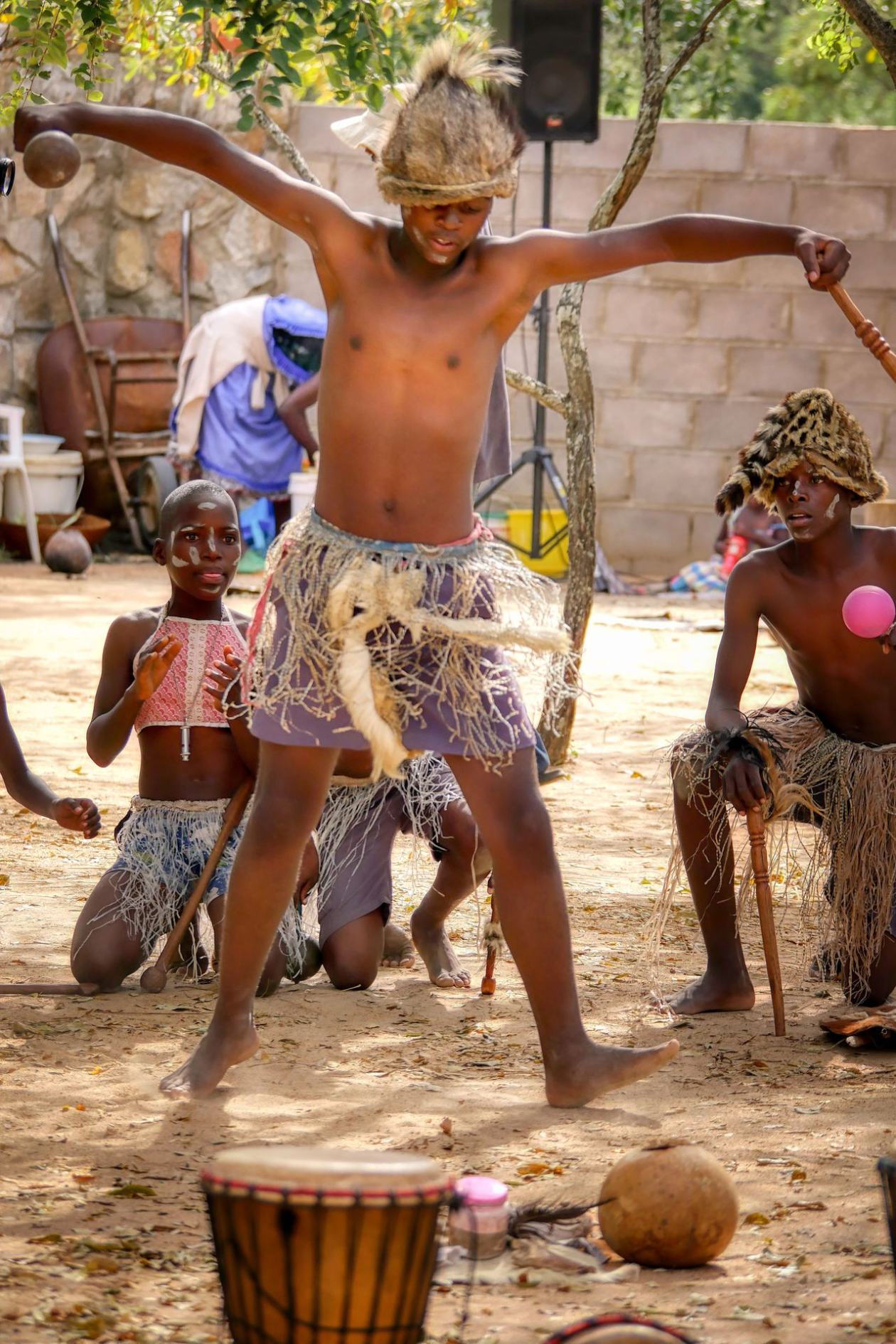
Experience the Living Cultures of Zimbabwe
Zimbabwe is not only dramatic landscapes and powerful wildlife. It is also home to one of the oldest civilisations in southern Africa and a people whose warmth and resilience define the country.
With Onaluru Safari and Tours, you experience the country through meaningful encounters, guided with respect and local knowledge.
Food and Drink
Zimbabwean food is built on maize, meat, and a deep respect for the communal table. It is not complicated food, but it is satisfying, generous, and tied directly to the land and seasons.
Sadza is the foundation of virtually every meal in Zimbabwe. This thick, smooth porridge made from white maize meal is served with every main dish, shaped into a portion with the hand, and used to scoop up relishes and stews. Sadza ne nyama (sadza with meat) is the standard, but it is just as often served with muriwo (leafy greens), beans, or matemba (dried kapenta fish). The quality of the sadza, its texture and consistency, is a point of genuine pride for the cook.
Braai culture is strong here, as it is across southern Africa. Zimbabwean beef is excellent, and boerewors (a coiled beef sausage spiced with coriander and cloves) is a braai staple. Game meat, including impala, kudu, and warthog, appears on restaurant menus and safari camp tables and is typically leaner and more flavourful than domestic beef.
Road Runner chicken, the free-range village chicken that scratches around every homestead in rural Zimbabwe, is a genuine delicacy. It is tougher than commercial chicken but far more flavourful, slow-cooked in tomato and onion until tender. A plate of sadza with Road Runner chicken and a heap of leafy greens is Zimbabwean comfort food at its best.
Kapenta, the tiny dried fish from Lake Kariba and Lake Cahora Bassa, is a protein staple across the country. The fish are sun-dried, then fried with tomato, onion, and ground peanuts to create a relish that is crunchy, savoury, and surprisingly addictive. Dovi (peanut butter stew), made with chicken or vegetables, is another beloved dish with roots in Shona cooking.
On the drinks side, Chibuku, the commercially produced traditional sorghum beer sold in large cartons, is the people's drink, thick, opaque, and mildly sour. Zambezi Lager, brewed in Harare, is the national favourite among commercial beers. In the Eastern Highlands, locally grown coffee and tea are emerging as quality products worth seeking out.


Conservation and Wildlife
Zimbabwe has a long and respected tradition of wildlife management, and its national parks system, established in the colonial era and maintained since independence, covers roughly 13 percent of the country. The quality of the guiding here is widely regarded as the best in Africa, with Zimbabwe's professional guide training programme setting the gold standard for the continent.
Hwange National Park is the jewel of the system, supporting one of the largest and most diverse wildlife populations in southern Africa. The park relies on a network of over 60 pumped waterholes, originally established for wildlife management and now critical infrastructure during the dry season. The waterholes draw enormous concentrations of elephants, buffalo, and predators, and the game viewing around them is consistently spectacular.
Mana Pools, a UNESCO World Heritage Site, is managed with a deliberately light touch. There are no fences, limited infrastructure, and a philosophy of allowing visitors to experience the bush on its own terms. Walking safaris and canoe safaris are the signature activities, and the park's wild dog population is one of the healthiest in southern Africa.
Community-based conservation through the CAMPFIRE programme (Communal Areas Management Programme for Indigenous Resources) was pioneered in Zimbabwe in the 1980s and became a model for community conservation across Africa. The programme gives rural communities the right to manage and benefit from wildlife on their land, creating a direct economic incentive for conservation. While the programme has faced challenges in recent decades, its core principles remain influential.
The country's rhino conservation efforts, managed through a combination of government parks and private conservancies, have achieved notable results. The Lowveld Conservancies in the southeast, including Save Valley and Bubye Valley, hold significant populations of both black and white rhino and have been successful in reducing poaching through intensive monitoring and community engagement.
Explore our itineraries in Zimbabwe
Check out our trips, and feel free to ask us to personalize it based on what you'd like to see and visit!
Want to discuss your next trip in Zimbabwe?
Get in touch with our expert tour coordinator, they can answer all your questions and suggest itinerary to match your best expectations. Drop us a line, we will get back to you asap!