NAMIBIA
The land that time forgot to tame
Introduction
Namibia does not ease you in gently. The moment you land, the scale of it hits you. This is a country roughly twice the size of California, home to fewer than three million people, where the desert meets the Atlantic Ocean and elephants walk through dry riverbeds.
It is the second least-densely populated country in the world, which means you can drive for hours through scenery that feels like it belongs to you alone. No traffic jams to a viewpoint. No crowds at a watering hole. Just you, your guide, and something wild in the distance.
Namibia became independent in 1990 and has since built one of Africa's strongest conservation models, with nearly half the country under some form of protected status. The communities here are active partners in protecting the land, which means wildlife numbers are growing and the experience you get is the real thing.
Highlights
Sossusvlei & Deadvlei
The dunes at Sossusvlei are among the tallest in the world, shaped over millions of years and coloured a deep burnt orange. Deadvlei sits nearby: a white clay pan littered with the skeletal remains of ancient camelthorn trees, framed by towering dune walls. It looks unreal. It is not. Early morning, when the light rakes across the ridgelines, is something you will not forget.

Etosha National Park
Etosha is built around a vast salt pan that stretches further than the eye can see. During the dry season, wildlife gathers at the waterholes in numbers that rival any park in Africa: lions, leopards, elephants, rhinos, and hundreds of bird species, all coming to you. You simply park, wait, and watch. There are few places on earth where game viewing is this effortless and this rewarding.

Spitzkoppe
A cluster of ancient granite peaks rising sharply from the flat plains of central Namibia, worn into arches, chambers and passages by 700 million years of wind and weather. San rock paintings shelter in the overhangs, the camping is among the best in the country, and the silhouette of the peaks against a dark sky is one of those images that stays with you long after you leave.

The Skeleton Coast
The Skeleton Coast earned its name from the shipwrecks and whale bones that once lined its shores. Today it is one of Africa's most dramatic and least-visited wilderness areas: a long, foggy strip of coastline where desert meets sea, seals bark in their thousands, and brown hyenas and lions roam the beaches. Remote, strange, and unforgettable.

Fish River Canyon
The second largest canyon in the world and one of southern Africa's great natural wonders. The Fish River Canyon stretches nearly 160 kilometres through the southern desert, dropping up to 550 metres at its deepest. The hiking trail through the canyon is legendary. Even just standing at the rim and taking in the scale of it is worth the drive south. what are other highlights

Damaraland
Damaraland is raw, open country: a volcanic plateau of ancient rock engravings, desert-adapted elephants, and dramatic formations like the Brandberg Mountain and Twyfelfontein. This is where you come when you want the wilderness without the crowds. The communities here have protected this land for generations, and it shows.

Kolmanskop
A diamond mining town abandoned in the 1950s and slowly reclaimed by the desert. Sand drifts through the doorways of old hospital wards and ballrooms, and the light that falls through broken windows onto dune-filled floors has made Kolmanskop one of the most photographed places in southern Africa. It sits just outside Lüderitz and can be visited on a morning tour.

Caprivi Strip
The narrow finger of land that extends east from the main body of Namibia into the heart of southern Africa, bordered by four countries and defined by two major rivers. The Zambezi Region feels nothing like the rest of Namibia: the vegetation is thick and green, hippos and crocodiles move through the channels, and the birdlife is exceptional. It is also the gateway to Botswana's Chobe National Park, making it a natural junction point for multi-country itineraries.

Geography
Namibia sits on the southwestern edge of Africa, bordered by Angola and Zambia to the north, Botswana to the east, South Africa to the south, and the Atlantic Ocean to the west. That western coastline stretches for nearly 1,600 kilometres, making it one of the longer uninterrupted coastal wildernesses on the continent.
The country divides naturally into several distinct zones. The Namib Desert runs the entire length of the coast, a narrow but ancient strip of sand, gravel plains, and dune fields that in places reaches 160 kilometres inland. It is the oldest desert in the world, estimated at 55 million years old, and the source of Namibia's most iconic landscapes.
Moving east, the land rises onto the Central Plateau, a broad highland region sitting between 1,000 and 2,000 metres above sea level. This is where the capital Windhoek sits, and where most of the country's agriculture and population are concentrated. The plateau is marked by rocky hills, dry riverbeds called dongas, and wide open stretches of savanna and thornbush.
Further east, the land drops away into the Kalahari, a vast semi-arid basin of red sand and sparse scrub that Namibia shares with Botswana and South Africa. And in the far north, the landscape shifts again into the greener, wetter bushveld of the Kavango and Zambezi regions, where rivers run year-round and the vegetation thickens considerably.
The Caprivi Strip, now officially called the Zambezi Region, is a narrow finger of land that extends east from the main body of the country, sandwiched between Angola, Botswana, Zambia, and Zimbabwe. It is one of Namibia's most ecologically rich areas and feels nothing like the desert landscapes most people associate with the country.


Geology
Namibia sits on some of the oldest exposed geology on earth. Parts of the Namib Desert are underlain by Precambrian basement rock more than 500 million years old, and the sedimentary layers that built the dunes at Sossusvlei began accumulating roughly 55 million years ago. The landscape here is not just scenic. It is a record of deep time.
The dunes themselves are made of quartz sand carried by the Orange River from the interior of southern Africa, deposited at the coast, and then blown north by the prevailing winds over millions of years. The red colour comes from iron oxide coating the grains, and the older the dune, the deeper the red. The dunes at Sossusvlei are among the most iron-rich and therefore most vividly coloured in the world.
In the northwest, the geology shifts dramatically. Damaraland is a landscape of volcanic intrusions and ancient lava flows. The Brandberg Massif, Namibia's highest mountain at 2,573 metres, is a granite dome pushed up through the surrounding rock roughly 130 million years ago. Nearby, Twyfelfontein is home to one of the largest concentrations of rock engravings in Africa, etched into sandstone slabs by San hunter-gatherers over thousands of years.
The Fish River Canyon in the south was carved not by a single dramatic event but by millions of years of erosion and tectonic activity. The canyon's oldest rocks are around 1.8 billion years old. The canyon floor sits 550 metres below the rim in places, and the scale of it only becomes clear when you spot a hiker in the valley below and realise how small they look.
Along the Skeleton Coast, the cold Benguela Current sweeping up from Antarctica drives the coastal fog that gives the region its eerie character, and also feeds one of the most productive marine ecosystems in the world. The diamond-rich gravels of the Sperrgebiet, the restricted diamond mining area in the south, are a reminder that Namibia's geology has shaped not just its landscapes but its entire economic history.
Explore our itineraries in Namibia
Check out our trips, and feel free to ask us to personalize it based on what you'd like to see and visit!
Demographics and People
Namibia has a population of around 3 million people spread across a country the size of France and Germany combined. That works out to roughly three people per square kilometre, making it one of the most sparsely populated countries anywhere in the world. In the desert regions, you can drive for hours without passing a single settlement.
The country is home to more than a dozen distinct ethnic groups, each with their own language, traditions, and relationship to the land.
The Ovambo people make up around half the population and are concentrated in the north, particularly in the Oshana, Ohangwena, Oshikoto, and Omusati regions. The Ovambo were central to the independence struggle, and SWAPO, the party that led Namibia to independence and has governed it since 1990, draws most of its support from this group.
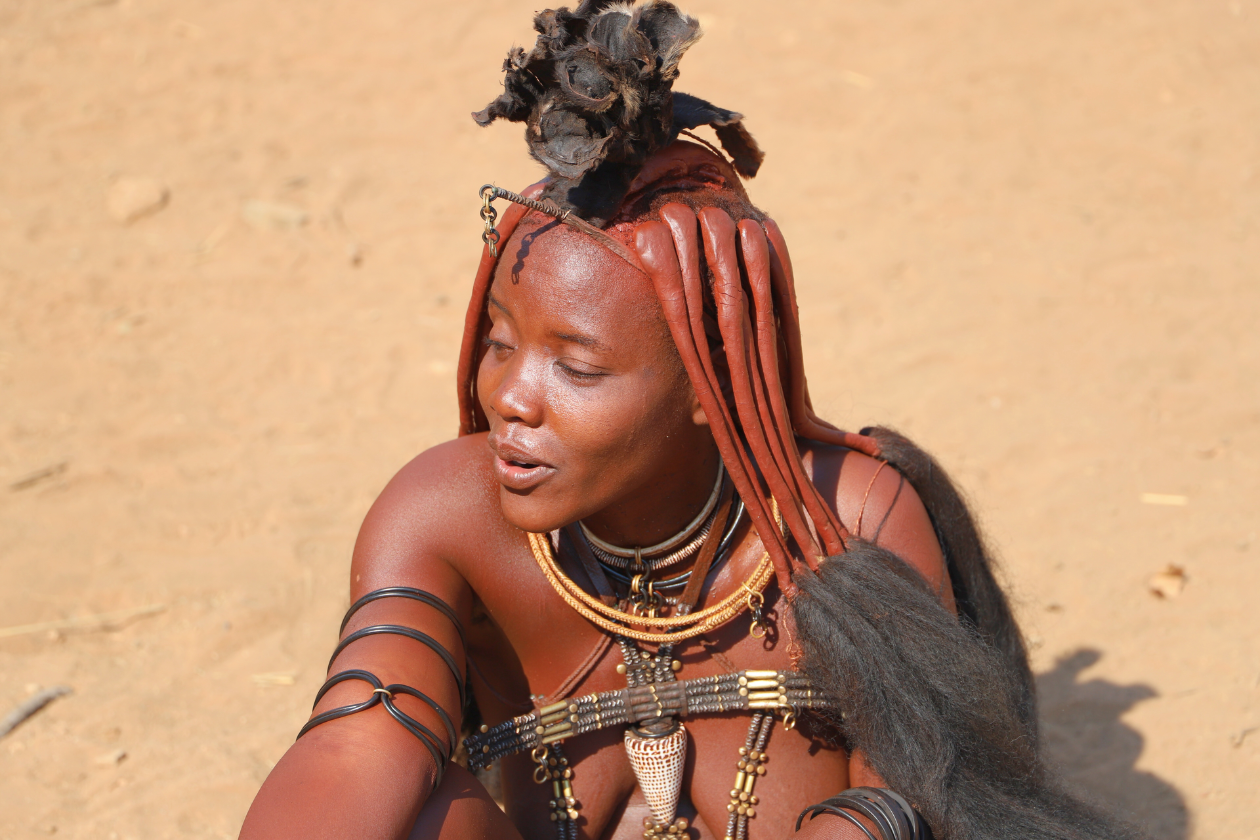
The Herero and Himba are closely related peoples whose history is both striking and painful. The Herero were the victims of what is now recognised as one of the first genocides of the twentieth century, carried out by German colonial forces between 1904 and 1908. Herero women still wear a distinctive Victorian-influenced dress, a legacy of German missionary influence, adapted over generations into something entirely their own. The Himba, who live mainly in the remote Kunene Region, have maintained a largely traditional way of life. Himba women are well known for covering their skin and hair in otjize, a paste made from butterfat and ochre that gives a deep red colour and protects against the sun and insects.
The Nama and Damara are among the oldest inhabitants of southern Namibia, with languages that include click consonants and cultural ties to the wider Khoikhoi and San peoples of southern Africa. The San, often called Bushmen, are hunter-gatherers whose presence in this part of the world goes back tens of thousands of years. They are the original inhabitants of the Kalahari and surrounding regions, and some communities in Namibia still maintain elements of their traditional knowledge of the land, plants, and wildlife.
The Kavango and Caprivi peoples of the north are river communities, culturally and practically oriented around the Okavango and Zambezi rivers, with traditions of fishing, woodcarving, and basketwork that are distinct from the pastoralist and desert cultures further south.
Windhoek and the coastal towns also have significant communities of Afrikaner and German descent, a legacy of colonial settlement that is visible in the country's architecture, food, and to some extent its institutional culture.
English is the official language, introduced at independence as a neutral choice among the many competing languages. But Oshiwambo, Afrikaans, Otjiherero, Khoekhoegowab, and several others are widely spoken in everyday life. Afrikaans in particular functions as a common second language across many communities and regions.


Culture and Traditions
One of the things that makes Namibia distinctive as a travel destination is that its cultural traditions are not put on for visitors. The Himba still live in traditional homesteads in the Kunene. The San communities of the Kalahari still track animals and read the land in ways that stretch back thousands of years. The Herero women still wear their striking Victorian-influenced dresses at markets and funerals and family gatherings.
Music and storytelling are central to most Namibian cultures. The San have a tradition of trance dance, used for healing and communication with the spiritual world, that is one of the oldest continuous ritual practices known. Himba and Herero communities mark important life events with ceremonies involving cattle, dress, and song. In the north, the efundula, or coming-of-age ceremony for Ovambo women, is a significant communal event.
Craft traditions are strong across the country. Basketwork from the Kavango and Zambezi regions is among the finest in Africa, using local grasses and natural dyes in patterns that carry cultural meaning. Woodcarving, beadwork, and leatherwork are all practised widely and sold at markets and craft centres. When you buy directly from community cooperatives and craft markets rather than airport shops, the money stays where it matters.
The German colonial legacy is visible in the architecture of Lüderitz and Swakopmund, in the bakeries that still sell Schwarzbrot and Brötchen, and in the names of streets and buildings across the country. This overlay of European history on African landscape gives Namibia an unusual and sometimes unsettling texture, but it is part of the honest complexity of the place.
Experience the Living Cultures of Namibia
Namibia is not only vast landscapes and wildlife. It is also home to ancient traditions and vibrant communities.
With Onaluru Safari and Tours, you experience the country through meaningful encounters, guided with respect and local knowledge.
Food and Drink
Namibian food is not internationally famous, but it is honest, flavourful, and deeply connected to the land. Meat is central to the culture across almost all communities, and Namibian beef, lamb, and game are genuinely excellent, raised on open rangeland with no factory farming in sight.
Braai is the institution. Across all cultures and communities, cooking meat over an open fire is the social ritual that holds everything together. An invitation to a braai is an invitation into Namibian life. The cuts are generous, the fires burn long, and the conversations go on even longer.
Kapana is the street food of Namibia. In the informal markets on the edge of Windhoek and in the Oshana region, vendors grill small pieces of beef over charcoal and serve them with chilli sauce and a sprinkle of spice. It is simple, cheap, and one of the best things you can eat in the country. The Soweto Market in Windhoek is the classic place to try it.
Potjiekos is a slow-cooked stew made in a three-legged cast iron pot over open coals. Vegetables, meat, and spices are layered in and left to cook slowly for hours. It is a dish shared between the Afrikaner and mixed-heritage Namibian communities and eaten at gatherings and celebrations.
Mopane worms (the caterpillar of the Emperor moth) are a high-protein staple in the north, eaten dried and salted as a snack or cooked into stews. They have a rich, earthy flavour and are worth trying if you are curious.
Omaheke porridge and other maize-based dishes are eaten across the country as everyday staples, often served alongside slow-cooked beef, dried fish from the Kavango rivers, or wild spinach.
On the coast, the cold Benguela Current that makes the Skeleton Coast so dramatic also makes the waters extraordinarily productive. Fresh fish, oysters, and crayfish (rock lobster) from Lüderitz and Swakopmund are a genuine highlight. The oysters from Lüderitz are among the best in the world, farmed in the cold, clean waters of the bay.
German baking survives in the bakeries of Swakopmund and Lüderitz: proper rye bread, Berliner doughnuts, strudel, and strong coffee served in cheerful contradiction to the desert outside.
Namibian craft beer has grown significantly in the last decade, with Windhoek Lager remaining the national standard and smaller craft breweries emerging in the capital. Locally distilled spirits from the Namibian Craft Distillery and others are worth exploring.


Conservation and Wildlife
Namibia runs one of the most successful community-based conservation programmes in Africa. The communal conservancy model, launched in the 1990s, gives local communities legal rights over the wildlife on their land and a direct financial stake in protecting it. There are now more than 80 registered communal conservancies covering around 20 percent of the country.
The results are visible. Black rhino populations, which were hunted to near-extinction, have recovered substantially. Desert-adapted elephants, lions, and leopards move through Damaraland and Kunene in numbers not seen for decades. Cheetah populations, under pressure from livestock farming across much of Africa, are more stable in Namibia than almost anywhere else on the continent.
This is not conservation managed at arm's length. The guides who take you into the Damaraland wilderness grew up there. The trackers who read the sand for lion prints are from the communities that live alongside those lions. When the model works, it works because the people with the most to gain or lose are the ones making the decisions.
Etosha National Park remains the centrepiece of Namibia's protected area network, but the communal conservancies north and west of the park have expanded the effective wildlife range enormously, creating corridors for elephant and predator movement across hundreds of thousands of hectares.
Explore our itineraries in Namibia
Check out our trips, and feel free to ask us to personalize it based on what you'd like to see and visit!
Want to discuss your next trip in Namibia?
Get in touch with our expert tour coordinator, they can answer all your questions and suggest itinerary to match your best expectations. Drop us a line, we will get back to you asap!